 Koboshi
New to moving to Japan? The main routes, and what every route asks for, are on Japan visa requirements in 2026. This page covers one route: the work visa for engineers and office specialists.
Sources checked: 2026-10-23 to 2026-11-08.
What is the Japan engineer visa?
It is Japan’s work visa for specialist office jobs at a company in Japan. Its official name is Engineer/Specialist in Humanities/International Services (技術・人文知識・国際業務, gijutsu jinbun chishiki kokusai gyomu), often shortened to gijinkoku. This page calls it the engineer visa.
The job must use knowledge from the sciences or humanities, or, in the law’s words, “thinking or sensibility rooted in a foreign culture” (Immigration Services Agency of Japan (ISA), law and ordinance extract). ISA’s examples include engineers, interpreters, designers, language teachers at private companies and marketing staff (ISA engineer visa page).
- How many hold it: 516,184 people at the end of June 2026, the largest group after permanent residents (961,342) (ISA, foreign residents at the end of June 2026). Every status is counted in Japan visa statistics 2026.
- Jobs it excludes: jobs advertised as “no experience needed, you will soon get used to it”, and work that Japanese staff without the required degree or experience normally do (ISA guideline, revised April 2026).
What degree or experience do you need for the Japan engineer visa?
You need one of these five qualifications (ISA law and ordinance extract):
- A university degree in a related subject. Foreign degrees count. ISA says it judges the link between degree and job “flexibly”, including for foreign universities (ISA guideline).
- A Japanese vocational school diploma with the title Diploma (専門士, senmonshi) or Advanced Diploma (高度専門士, kodo senmonshi). Your main subject must have a “substantial” link to the job.
- 10 years of related work experience. Years spent studying a related subject count toward the 10.
- For IT jobs, a listed IT exam or qualification. Passing an exam or holding a qualification on the Justice Minister’s list replaces the degree or experience.
- For international-services work, 3 years of related experience. This covers translation, interpreting, language teaching, public relations, advertising, overseas trade, fashion or interior design and product development. University graduates who will translate, interpret or teach a language need no experience.
Is there a minimum salary for the Japan engineer visa?
ISA sets no fixed amount in yen. Your pay must at least equal what a Japanese person doing the same work would receive (ISA law and ordinance extract).
Allowances that only repay costs, such as commuting, family and housing allowances, count toward pay only when they are taxed (ISA guideline).
Do you need Japanese for the Japan engineer visa?
For most engineering and IT jobs, ISA sets no Japanese level. You need B2 (about JLPT N2) when the job mainly means dealing with people through language.
Before: the engineer visa had no language-level rule. ISA’s notice lists the B2 proof as an extra document for applications from 2026-04-15 (ISA engineer visa page).
Now, for applications from 2026-04-15: ISA expects B2 in the language the job uses, for work that mainly means dealing with people through language (ISA engineer visa page; ISA guideline, Attachment 4).
- Jobs ISA names: translation, interpreting, and customer service such as a hotel front desk.
- Engineering, IT and back-office work: ISA does not name them. It can still ask for proof in any case.
- Who must show proof: people applying from abroad, and people changing status inside Japan, such as from Student to the engineer visa, when the employer is in ISA’s category 3 or 4 (mostly smaller companies). At employers in categories 1 and 2, such as listed companies, ISA may still ask.
- Renewals: proof is normally needed only if a new job or new duties moved you into language work, but ISA may still ask.
- Proof for Japanese: JLPT N2 or N1, a BJT (Business Japanese Proficiency Test) score of 400 or more, and five other forms. All seven are on Japan work visa requirements 2026.
The full JLPT and CEFR table is on Japan work visa requirements 2026.
How much Japanese do IT employers in Japan ask for?
It depends on the team’s working language. Teams that work in English often ask for no Japanese. Teams that work in Japanese usually ask for business level. Our view: JLPT N2 is the practical floor for discussing complex tasks with Japanese colleagues.
- On a job board for English speakers: of 269 listings on Japan-Dev on 2026-11-08, 121 (45%) said Japanese was not required, 103 (38%) asked for business level, 24 asked for fluent and 21 for conversational. The board is built for English speakers, so it shows more English-only jobs than the market as a whole.
- Across employers: in a February 2024 survey of 1,000 HR staff by Human Holdings, 37.5% of information and communications companies asked foreign hires for JLPT N1 or N2 (日本の人事部 (Nihon no Jinjibu), reporting the survey). The survey counts N1 and N2 together.
- Juniors use more Japanese: in TokyoDev’s survey of 989 international developers in Japan (September 2025), 51% of those with 3 years of experience or less used only English at work, against 74% of those with 10 years or more (TokyoDev 2025 survey).
- Companies that work in English: Mercari said in May 2022 that “roughly 50% of the engineering organization based in Mercari’s Tokyo office is composed of non-Japanese engineers”, and that it hired 29 graduates of the Indian Institutes of Technology (IIT) in 2018 alone (Mercari, 2022-05-11). PayPay said in June 2024 that about 80% of its engineers were non-Japanese (PayPay, 2024-06-07).
- Where N1 pays: on the Highly Skilled Professional points table, N1 adds 15 points and N2 adds 10 (ISA points table).
How many Indians hold the Japan engineer visa?
15,118 Indian nationals held the engineer visa at the end of June 2026, up from 12,177 at the end of 2023. During 2025, 2,838 Indian nationals arrived in Japan on it.
Two kinds of number appear here, and they count different things:
- Total holders (a stock): everyone holding the visa on one date.
- New arrivals (a flow): people who entered Japan from abroad on this visa during one year. ISA calls them new entrants (新規入国者, shinki nyukokusha). The count leaves out people already in Japan who switch to the visa, such as graduates moving from a student visa.
| What it counts | All nationalities | Indian nationals | India’s share |
|---|---|---|---|
| Total holders, end of 2023 | 362,346 | 12,177 | 3.36% |
| Total holders, end of 2024 | 418,706 | 13,619 | 3.25% |
| Total holders, end of 2025 | 475,790 | 14,567 | 3.06% |
| Total holders, end of June 2026 | 516,184 | 15,118 | 2.93% |
| New arrivals during 2025 | 61,528 | 2,838 | 4.6% |
Sources: ISA foreign resident statistics for the end of 2023, the end of 2024, the end of 2025 and the end of June 2026; new arrivals from ISA’s entry statistics for 2025, Table 5. Each share is the Indian number divided by the all-nationalities number on the same line.
- Indian holders rose every year: up 2,941 people, or 24.2%, from the end of 2023 to the end of June 2026.
- India’s share fell from 3.36% to 2.93% over the same period, because holders from other countries grew faster: all holders rose 42.5%. At the end of June 2026, China had 126,749 holders, Vietnam 126,159, Nepal 60,950, Sri Lanka 22,803 and Myanmar 19,198.
- New arrivals: in 2025, Vietnam (14,433), China (12,340) and Nepal (6,005) each sent more people on this visa than India (2,838). New arrivals from all countries rose from 43,787 in 2023 to 61,528 in 2025 (ISA, entry statistics for 2025, Table 4).
- All Indians in Japan: 61,344 lived in Japan at the end of June 2026 (a total), on every kind of visa (ISA, June 2026).
The two governments’ goal: in August 2025, India and Japan agreed an action plan for 500,000 people moving between the two countries over five years, “including 50,000 skilled and semi-skilled personnel from India to Japan”, in the words of India’s Foreign Secretary Vikram Misri (The Tribune, 2025-08-29). The 50,000 is a goal for skilled and semi-skilled workers in general.
Will AI make junior engineer jobs in Japan harder to get?
In the United States, the data already shows fewer young workers than expected in the jobs most exposed to AI. Japan’s data shows no clear effect yet. Our view: AI is squeezing junior engineering work, Japan is among the markets less affected, and juniors who cannot work in Japanese carry the most risk.
What the data shows
- United States: employment of workers aged 22 to 25 in the jobs most exposed to AI “now stands 19% below where it would be had it kept pace” with less exposed jobs, according to the Stanford Digital Economy Lab’s August 2026 revision of “Canaries in the Coal Mine?”, based on payroll data through June 2026 (Stanford Digital Economy Lab). The authors describe the pattern and do not claim AI caused it.
- Japan, large employers: in a Recruit Works Institute survey of 186 large companies (February to March 2026, released 2026-06-30), 68.8% said AI and other technology would not change how many new graduates they hire; 7.5% said they would hire more and 7.5% fewer (Recruit Works Institute, via PR TIMES).
- Japan, engineer hiring: in a July 2025 Findy survey of 220 companies, 25.0% planned to hire more engineers because of AI and 23.2% fewer (ITmedia, 2025-09-03).
Our view
- Small teams now build their own systems. With better AI, small businesses and small teams build software they once paid for. That has created a new job: fixing the mess less experienced builders leave. 404 Media reported in September 2025 that “freelance developers and entire companies are making a business out of fixing shoddy vibe coded software” (404 Media, 2025-09-11). Vibe coding means building software by describing it to an AI and accepting the code it writes.
- Junior work tends to go to people who share the language. For junior work, we expect many Japanese companies to prefer a Japanese junior with basic security and building skills, or anyone with a few years of experience, over a junior from abroad (from India, for example) who cannot yet work in Japanese. AI lowers the cost of a junior’s code. The cost of a language gap stays.
- Text has narrowed the language gap; voice still lags. Chat tools and AI translation let an engineer without fluent Japanese do much more with Japanese colleagues in writing. Meetings, calls and quick talk at the desk still run on spoken Japanese.
- Japan is among the markets less affected. Japanese companies expect a named person to answer for each system, a culture of responsibility (責任, sekinin) that keeps human checks in place. Products for consumers still need engineers. What changes is the engineer’s role (next section).
The case against our view
- Explicit context may be an advantage. Ken Wakasa, a former Mercari group CTO, said in an @IT interview series published on 2026-09-30 (our translation) that Indian engineers are “gaining presence in the AI era”. Living among 22 languages recognised by India’s constitution, “the assumption that things are understood without saying does not hold”, and when they speak English they “consciously switch to a low-context mode”. For AI agents, he said, unspoken knowledge “is the same as not existing” (@IT, 2026-09-30). His point, as we read it: engineers used to stating context plainly are well placed to work with AI.
- AI may shrink the language barrier. Russell Kaplan, president of Cognition, told Fortune that Japan was Cognition’s “first or second most popular country in terms of user engagement overall”. Cognition makes Devin, an AI coding agent. Fortune reported that Japanese engineers can “work with Devin entirely in Japanese” while working with teams abroad (Fortune, 2026-07-03).
- Arrivals are still rising. New arrivals on the engineer visa rose 8.8%, from 56,532 in 2024 to 61,528 in 2025 (ISA, entry statistics for 2025, Table 4).
Our view, for a junior developer abroad: choose a lane. Either target the English-language teams above, or bring your Japanese to N2 for Japanese-language teams. A few years of real work at home, plus basic security skills, make either lane easier.
How are engineering roles changing in the AI era?
Teams are getting smaller and roles are merging. Gartner predicted on 2026-07-07 that 60% of organizations will adopt smaller software engineering teams by 2029, up from 15% in 2026, often of four or five people: a product manager, a user or agent experience designer and at least one AI-native software engineer (Gartner press release, 2026-07-07; CIO Dive, 2026-07-10).
Gartner analyst Aliyah Camacho said, as quoted by CIO Dive, that “due to AI-driven compression of roles and competencies, software engineers are becoming” product engineers. She also warned in Gartner’s release that “slowing junior-level hiring could lead to significant pitfalls, including inhibiting knowledge transfer, restricting the internal talent pipeline, and limiting recruitment to more expensive and competitive senior roles” (CIO Dive, 2026-07-10; Gartner press release, 2026-07-07).
Our view: this chart is the likely future.
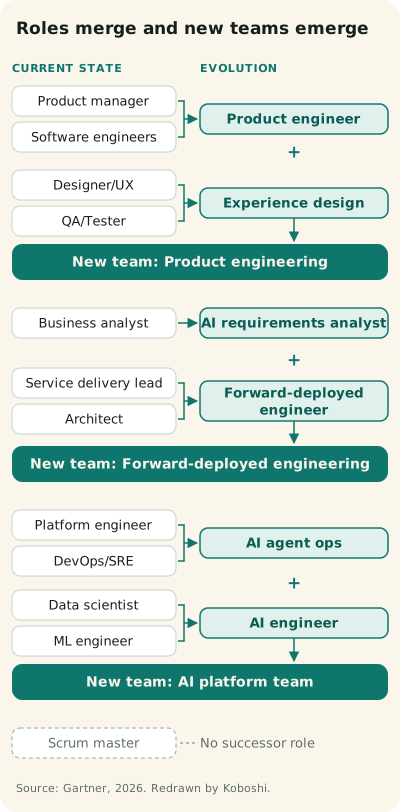
Source: Gartner, “Roles merge and new teams emerge” (© 2026 Gartner, Inc., graphic CTMKT_5449985), as shared on X by 久保田雅也 (@kubotamas) on 2026-10-11. It is not part of the press release linked above. Redrawn by Koboshi.
Three of the new names, in plain words:
- Product engineer: an engineer who also decides what to build.
- Forward-deployed engineer: an engineer who works with a customer, on the customer’s own systems.
- AI agent ops: the people who run, watch and fix AI agents at work.
Each merged role sits closer to customers and the business, so it talks more. Our reading: in a Japanese-speaking company, each of these roles needs more conversation in Japanese.
How long can you stay on the Japan engineer visa, and what does renewal cost?
ISA grants 5 years, 3 years, 1 year or 3 months (ISA engineer visa page). A dispatched worker’s stay follows the dispatch contract.
The fee for a renewal or a change of status changed on 2026-10-01 (ISA fee leaflet, September 2026):
- Before: 6,000 yen at the counter, or 5,500 yen online, whatever the length of stay.
- Now: the fee depends on the length of stay granted. Applications received by 2026-09-30 still pay the old fee.
| Stay granted | At the counter | Online |
|---|---|---|
| 3 months | 10,000 yen | 10,000 yen |
| 1 year | 33,000 yen | 27,000 yen |
| 3 years | 64,000 yen | 56,000 yen |
| 5 years | 75,000 yen | 65,000 yen |
Online payment is by convenience store or bank, plus a payment fee.
Can you switch from a Japan student visa to the engineer visa?
Yes, you can apply to change your status once you have a job. ISA checks your conduct, including whether you kept to the student work limit. In ISA’s words (our translation), a student who habitually works part-time over 28 hours a week “is not regarded as having good conduct” (ISA guideline).
- Student work limit: 28 hours a week, and 8 hours a day during long school holidays (ISA, part-time work permission).
- Residence card: required updates, such as an address change, must be up to date.
- Japanese: if the new job mainly means dealing with people through language and the employer is in ISA’s category 3 or 4, the B2 proof applies to the change.
- Waiting for a job to start: graduates of a Japanese university or vocational school can stay on Designated Activities (特定活動, tokutei katsudo) until the job starts (ISA, job offer holders).
- Still job hunting: those graduates can job-hunt on Designated Activities for up to 1 year, or 2 years with a qualifying local-government programme (ISA, job hunting after graduation).
Is Japan’s Highly Skilled Professional visa worth aiming for?
Our view: yes, if you can reach 70 points. The Highly Skilled Professional visa (高度専門職, kodo senmonshoku) covers the same kind of specialist and IT work as the engineer visa, through a points system, and needs at least 3,000,000 yen a year in pay. ISA lists these benefits (ISA deck on highly skilled foreign workers, 2025-09-29):
- A 5-year stay.
- Faster processing.
- A shorter wait for permanent residence: 3 years at 70 points, or 1 year at 80 points, for people ISA recognised as highly skilled at that score.
Japanese adds 10 points for JLPT N2 and 15 for N1 (ISA points table).
What must employers check for the Japan engineer visa in 2026?
Employers must check hiring bans, a declaration about the company’s head and, for dispatch work, where the worker will work (ISA guideline).
- Hiring bans: as a rule, a company under a hiring ban in the Specified Skilled Worker or Technical Intern Training systems may not take new workers on this visa during the ban. Reasons include violence, taking passports, unpaid wages and other serious rights abuses.
- Declaration about the company’s head: for applications filed from 2026-04-15, companies outside ISA’s top two groups (such as listed companies, and companies paying 10 million yen or more a year in tax withheld from salaries) attach a declaration about the company’s representative (ISA engineer visa page; ISA reference form).
- Dispatch work (派遣, haken): for applications filed from 2026-03-09, ISA asks for new documents about the dispatch. The client company where the worker will work must already be decided, or ISA gives no permission. ISA may check with the client company directly. An exception covers placements that can only be decided after training for new staff (ISA, dispatched workers, July 2026).
Before you apply: This page is general information, not legal advice. Meeting these rules does not guarantee a visa; ISA decides each case. Rules change, so check ISA’s engineer visa page on the day you apply. For your own case, ask a lawyer registered in Japan (弁護士, bengoshi) or an administrative scrivener approved to file immigration applications (申請取次行政書士, shinsei toritsugi gyoseishoshi). Sources last checked: 2026-10-23 to 2026-11-08.
