 Koboshi
Sources checked: 2026-10-23 to 2026-11-08. Page reorganised on 2026-11-13: the JLPT and CEFR table moved to Japan work visa requirements in 2026, and the resident counts and the timeline of rule changes to Japan visa statistics 2026; no rule or number changed.
Which Japan visa guide do you need?
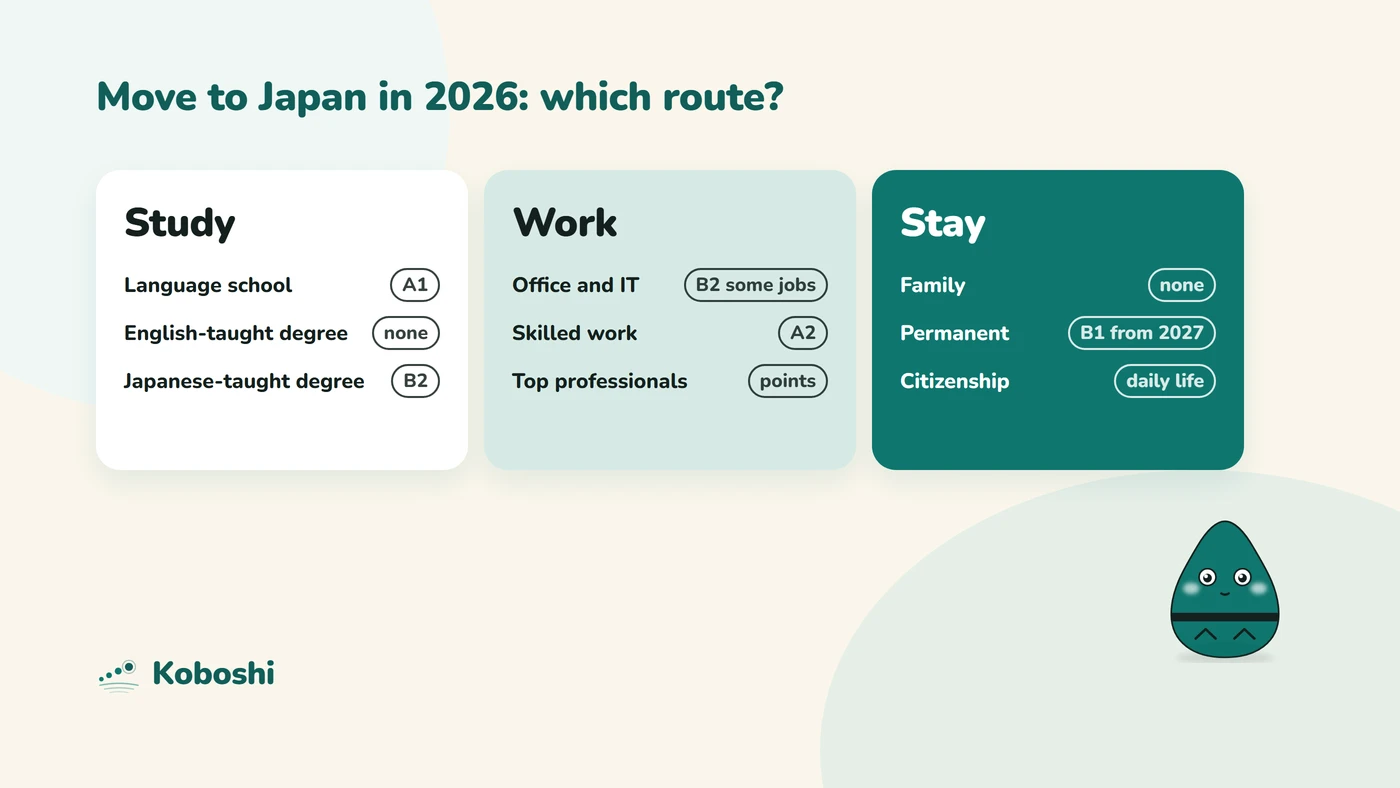
Japan has seven main routes, plus citizenship for people who have lived there for years. Each route is a “status of residence” (在留資格, zairyu shikaku): the permission that says what you may do in Japan. The Immigration Services Agency of Japan (ISA), the government office for visas, decides each case.
Find the row that fits you. Routes without a full guide yet have a summary further down this page.
Study
| Route | What you need | Japanese level | Full guide |
|---|---|---|---|
| Study | A place at a school in Japan, and money to live on | A1 (about JLPT N5) for a language school; B2 (about N2) for university courses taught in Japanese, from the 2027 school year | Japanese language schools in 2026; English-taught degrees in Japan |
Work
| Route | What you need | Japanese level | Full guide |
|---|---|---|---|
| Office and IT work | A job offer, plus a related degree, 10 years of experience or a listed IT exam | B2 (about N2), only for jobs that mainly use language to deal with people | Japan engineer visa in 2026; for the N2 rule, Japan work visa requirements in 2026 |
| Skilled work without a degree | A skills test and a job in one of 19 fields | A2 (about N4) | Japan SSW restaurant visa in 2026, which also shows the room left in every field |
| Trainee work | An employer that takes trainees | A1 (about N5) or a Japanese course, from 2027-04-01 | No guide yet; summary below |
| Top professionals | For specialist and IT work: 70 points and pay of at least 3,000,000 yen a year | No set level; N1 adds 15 points, N2 adds 10 | Japan HSP points calculator |
Family and staying for good
| Route | What you need | Japanese level | Full guide |
|---|---|---|---|
| Family | A husband, wife or parent in Japan who is Japanese, or who holds a status that allows family | No set level | No guide yet; summary below |
| Permanent residence | Usually 10 years living in Japan | B1 (about N3) as one factor, from 2027-04-01 | No guide yet; summary below |
| Japanese citizenship | Usually 10 years living in Japan, since 2026-04-01 | Enough for daily life: speaking, reading and writing | Japan naturalization requirements checklist |
The levels in these tables are CEFR levels (the Common European Framework of Reference for Languages, A1 to C2), each with its rough JLPT (Japanese-Language Proficiency Test) match. The full table, with the JLPT scores that decide each level, is in Japan work visa requirements in 2026.
Below, each route in turn: what it requires in 2026, what changes on 2027-04-01 for the routes it affects, and where its full guide is. How many people hold each status, and how the rules have changed since 2019, are in Japan visa statistics 2026.
What does each route to Japan require in 2026?
Each route asks for something different: a school place, a degree or experience, a skills test, points, or a family tie. Most routes start with a Certificate of Eligibility (COE), the document you need before you get the visa.
Study
Student (留学, ryugaku) is the status for language schools, universities and vocational schools.
- How long: ISA gives up to 4 years 3 months at a time (ISA student page).
- Japanese: a language school needs A1 (about JLPT N5). Since the October 2026 intake, you must show it with a test or a school interview; 150 hours of study no longer counts (ISA language school rule). University courses taught in Japanese expect B2 (about N2) from students starting in the 2027 school year, which begins in April 2027 (ISA student Japanese rule). Any N2 pass counts as B2 here, with no score cutoff, for students who start school up to the 2029 school year.
- Part-time work: with permission, up to 28 hours a week, and up to 8 hours a day in long school holidays (ISA work permission for students).
Full guides: Japanese language schools in 2026, and Japanese universities that teach in English.
Office and IT work
Engineer/Specialist in Humanities/International Services (技術・人文知識・国際業務, gijutsu jinbun chishiki kokusai gyomu), often shortened to gijinkoku, is the main visa for office, IT and engineering jobs.
- Who qualifies: you need a job offer and a related degree, 10 years of related work or, for IT jobs, a listed IT exam. Your pay must be at least what a Japanese worker gets for the same job (ISA law and rules extract).
- Japanese: before 2026-04-15, this visa had no Japanese rule. Since then, jobs that mainly use language to deal with people, such as interpreting or a hotel front desk, need B2 (about JLPT N2) (ISA office work visa page). Any N2 pass counts as B2: ISA sets no score cutoff for N2.
Full guides: Japan engineer visa in 2026, with every qualification route and the pay rule, and Japan work visa requirements in 2026 for the Japanese rule.
Skilled work without a degree
Specified Skilled Worker (特定技能, tokutei ginou), or SSW, is for fields that are short of workers. It has two levels (ISA SSW overview, updated 2026-09-29):
- Type 1: 19 fields, such as nursing care, construction and food manufacturing; two new fields, warehousing and recycling, open only when ISA is ready. You pass a skills test and an A2 Japanese test: JFT-Basic (the Japan Foundation Test for Basic Japanese) at A2, or JLPT N4. You can stay up to 5 years in total.
- Type 2: 11 fields, for experienced workers. There is no total limit on your stay, and your husband or wife and children can join you.
- Restaurants are closed for now: ISA has paused new COEs for food service. Applications received from 2026-04-13 are refused.
- From 2027-04-01: today, restaurant and fishing SSW Type 2 ask for JLPT N3 or higher (about B1). From 2027-04-01, every Type 2 field asks for B1 (about JLPT N3), and bus, taxi and railway staff on Type 1 move from “JLPT N3 or higher” to “B1 or higher”. This covers COE applications, made by people outside Japan. For people already in Japan who change or renew their status, ISA has not set the start date yet. For every B1 rule that starts on 2027-04-01, here and for permanent residence, ISA has not said which tests count as proof (ISA 2027 language rules).
Full guide, with the room left in every field: Japan SSW restaurant visa in 2026.
Trainee work
Technical Intern Training (技能実習, gino jisshu) is today’s trainee route. Employment for Skill Development (育成就労, ikusei shuro) replaces it on 2027-04-01 (ISA Employment for Skill Development overview, July 2026).
- What it is: up to 3 years of work that trains you to SSW Type 1 level.
- Japanese: an A1 test (about JLPT N5) or a Japanese course to start; A2 (about N4) to move up to SSW Type 1.
- Changing employer: allowed by your own choice under set conditions, such as passing a skills test and a Japanese test.
Highly Skilled Professional points
Highly Skilled Professional (高度専門職, kodo senmonshoku), or HSP, is a points system for top professionals.
- The bar: for specialist and IT work, 70 points and pay of at least 3,000,000 yen a year. JLPT N1 adds 15 points; N2 adds 10 (ISA points rules).
- The reward: a faster path to permanent residence. With 70 points held without a break you may apply after 3 years; with 80 points, after 1 year (ISA permanent residence guideline, 2026-10-01).
Full guide, with a points calculator and the document behind each point: Japan HSP points in 2026.
Family
- Family of a foreign resident: Dependent (家族滞在, kazoku taizai) is for the husband, wife or child of someone on most work statuses, a student, or an SSW Type 2 worker. SSW Type 1 workers and technical interns cannot bring family on it. Parents cannot use it (ISA Dependent page).
- Work: a Dependent family member may work up to 28 hours a week with permission (ISA work permission for Dependents).
- Family of a Japanese citizen: Spouse or Child of Japanese National (日本人の配偶者等, nihonjin no haigusha to).
Permanent residence and citizenship
Permanent residence (永住, eiju) is the status for staying in Japan for good (ISA permanent residence guideline, 2026-10-01).
- Time: usually 10 years in Japan, with at least 5 of them on a work or residence status. Years on SSW Type 1, Technical Intern Training, Employment for Skill Development or a company transfer (Intra-company Transferee) do not count toward those 5.
- Income and payments: your household income should be above the average for a Japanese household of the same size. ISA also checks that you paid taxes and social insurance. Both rules apply to applications filed from 2026-04-01 and still waiting on 2026-10-01, and to every later one.
- From 2027-04-01: applications filed from that date follow the 2026-10-01 guideline in full; those filed before follow the previous guideline. The guideline adds a pension check and counts B1 Japanese (about JLPT N3) as one factor; which tests prove B1 is not set yet. The Japanese factor does not apply to HSP holders and their families, people with 6 or more years of schooling, or Japan-born children of a permanent resident parent who has B1. The husband or wife of a Japanese citizen or permanent resident needs 5 years of real married life and 3 years living in Japan.
- Fee: 200,000 yen at the immigration office for applications received from 2026-10-01, up from 10,000 yen (ISA fee leaflet; ISA fee Q&A).
- Losing permanent residence: from 2027-04-01, ISA can take it away for not paying taxes or social insurance on purpose, for breaking immigration duties such as residence card rules, or for a prison sentence for listed crimes, even a suspended one (ISA page on cancelling a status). This comes from Law No. 60 of 2024. Illness, disaster, job loss, a payment plan you keep, or living on support at the level of welfare (seikatsu hogo) do not count as “on purpose”; taxes left unpaid on purpose before 2027 can still count if found later. Unless ISA judges the person unfit to stay, it moves them to another status instead, usually Long-Term Resident (ISA revocation guideline, 2026-10-01).
Japanese citizenship (帰化, kika): the Nationality Act asks for 5 years of living in Japan, and the Ministry of Justice expects enough Japanese for daily life: speaking, reading and writing (Ministry of Justice naturalization page). Since 2026-04-01, the Ministry of Justice asks for 10 years as a rule (Minister of Justice press conference, 2026-03-27). Full guide: Japan naturalization requirements checklist.
Before you apply: This page is general information, not legal advice. Meeting these rules does not guarantee a visa; ISA decides each case. Rules change, so check ISA’s website on the day you apply. For your own case, ask a lawyer registered in Japan (弁護士, bengoshi) or an administrative scrivener approved to file immigration applications (申請取次行政書士, shinsei toritsugi gyoseishoshi). Sources last checked: 2026-10-23 to 2026-11-08.
