 Koboshi
Sources checked: 2026-10-23 to 2026-10-27.
This page explains the Japanese level each route to Japan asks for. It focuses on the office work visa, Engineer/Specialist in Humanities/International Services (技術・人文知識・国際業務, gijutsu jinbun chishiki kokusai gyomu), often shortened to gijinkoku, whose rule changed in 2026. For every route, its Japanese name and what else it requires, start with Japan visa requirements in 2026.
How do JLPT levels compare with CEFR levels?
JLPT and CEFR levels match only roughly. The JLPT (Japanese-Language Proficiency Test) runs from N5 (easiest) to N1. CEFR (the Common European Framework of Reference for Languages) runs from A1 (easiest) to C2.
| CEFR | JLPT | What you can do |
|---|---|---|
| A1 | N5 | Use basic phrases if the other person speaks slowly |
| A2 | N4 | Handle simple daily tasks: shopping, directions and basic tasks at work |
| B1 | N3, if you score 104 or more out of 180 | Follow clear speech about work, school and daily life |
| B2 | N2, if you score 112 or more | Talk with native speakers without difficulty; read work documents |
| C1 | N1, if you score 142 or more | Use Japanese fluently for work and study |
Since the December 2025 test, JLPT score reports show an N3 pass below 104 as A2, an N2 pass from 90 to 111 as B1, and an N1 pass below 142 as B2 (JLPT CEFR reference). The “What you can do” column is shortened from the Council of Europe CEFR scale.
The Immigration Services Agency of Japan (ISA) uses a simpler rule for the office work visa, and for students who start school up to the 2029 school year: any N2 pass counts as B2 (ISA student Japanese rule).
What Japanese level do you need for each Japan visa?
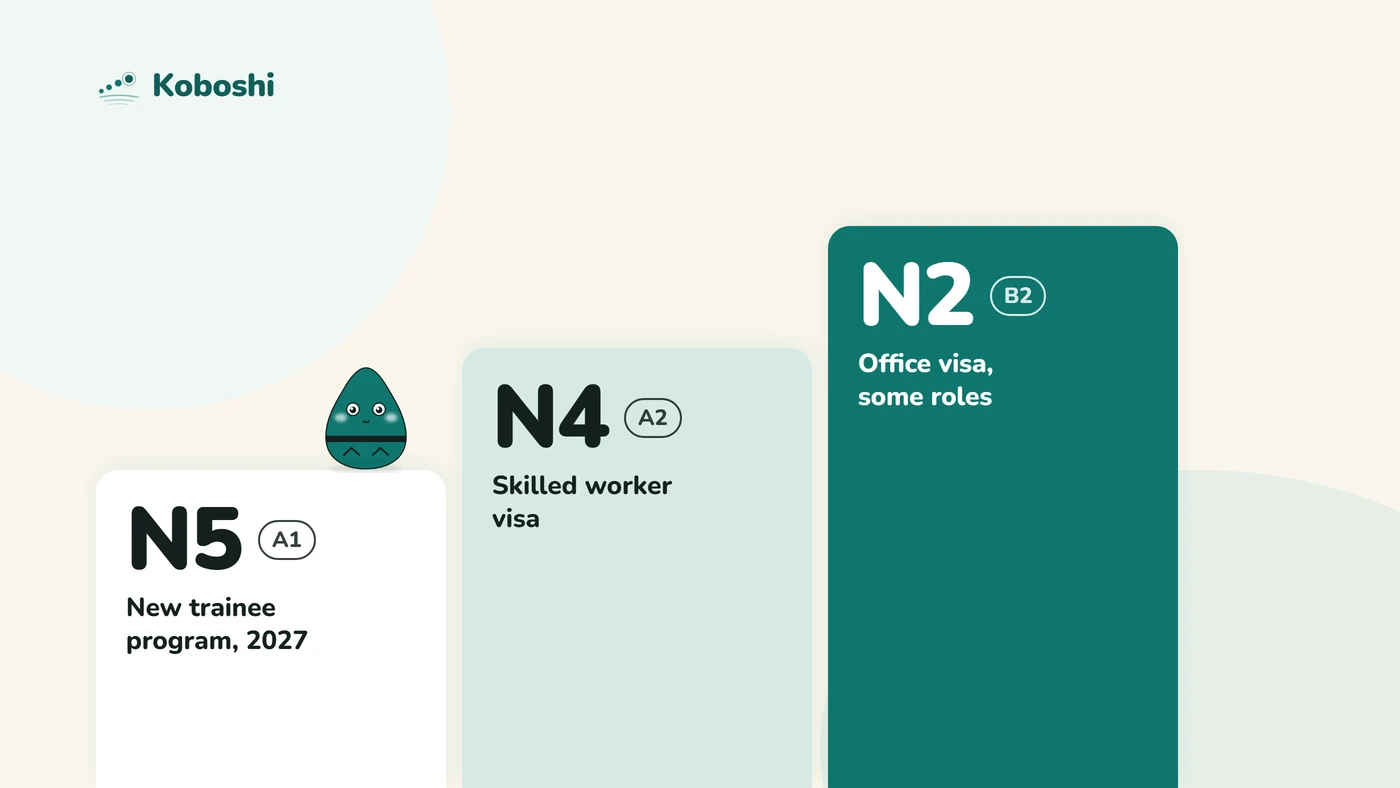
The requirement ranges from no set level to B2 (about JLPT N2), depending on your route and job.
| Route | Japanese needed | Since |
|---|---|---|
| Language school (Student, 留学, ryugaku) | A1 (N5), by a test or a school interview | October 2026 intake |
| University course taught in Japanese | B2 (N2) | students starting from April 2027 |
| Office work that mainly uses language with people | B2 (N2) | 2026-04-15 |
| Other office, IT and engineering work | No set level, unless the job is mainly language work | |
| Specified Skilled Worker (特定技能, tokutei ginou) Type 1 | A2 (N4) | now |
| Specified Skilled Worker Type 2 | Food service: JLPT N3 or higher (about B1). Other fields: B1 (about N3) | food service now; every field for applicants abroad from 2027-04-01 |
| Employment for Skill Development (育成就労, ikusei shuro) | A1 (N5) or a Japanese course to start; A2 (N4) to move up | 2027-04-01 |
| Highly Skilled Professional (高度専門職, kodo senmonshoku) | No set level; N1 adds 15 points, N2 adds 10 | now |
| Permanent residence (永住, eiju) | B1 (about N3), as one factor | applications from 2027-04-01 |
Sources: ISA language-school rule, ISA student Japanese rule, ISA office work visa page, ISA skilled worker overview, ISA 2027 language rules, ISA Employment for Skill Development overview, ISA points table, ISA permanent residence guideline.
The Specified Skilled Worker visa for restaurant work is closed to new applicants. See Japan’s SSW food service visa in 2026.
Is JLPT N2 now required for every Japan work visa?
No. The new rule covers the office work visa, and only jobs mainly using language with people. It expects B2 in the language used for the job.
Before: the office work visa required a degree or work experience, with no Japanese requirement. ISA’s February 2024 guideline had no language rule (ISA guideline).
In April 2026, Kyodo reported that the government acted because some people entered on this visa and then did simple labour the visa does not allow (Akita Sakigake, carrying Kyodo, 2026-04-03).
Now, for applications from 2026-04-15: ISA expects B2 if the job mainly involves using language to deal with people. In ISA’s words (our translation), B2 is expected where the applicant “mainly engages in interpersonal work using language ability” (ISA guideline, Attachment 4).
- Jobs ISA names: translation, interpreting and customer service such as a hotel front desk.
- Other jobs: ISA does not name engineering, IT or back-office work. It can still ask for proof in any case.
- Who must show proof: people applying from abroad or changing their visa inside Japan, such as from Student to the office work visa.
- Renewals: proof is normally needed only if a new job or new duties moved you into language work, but ISA may still ask.
- Employers: the B2 condition applies whatever the company’s size. Only the paperwork differs: most companies attach the proof to the application, while companies in ISA’s top two groups (listed companies, and companies paying 10 million yen or more a year in salary withholding tax) may be asked for it during review.
How can you prove B2 Japanese for the office work visa?
ISA accepts any one of these seven forms of proof (ISA office work visa page, re-read 2026-10-27):
- JLPT N2 or N1
- BJT (Business Japanese Proficiency Test) score of 400 or more
- EJU (Examination for Japanese University Admission) Japanese score of 200 or more, added 2026-10-14
- JPT (Japanese Proficiency Test) score of 525 or more, added 2026-10-14
- 20 years or more living in Japan
- A degree or diploma from a Japanese university, technical college (kosen) or vocational school, if your major relates to the job
- Completion of Japanese compulsory schooling and a Japanese high school
Check these details:
- JPT and J.TEST are different tests. J.TEST (the Test of Practical Japanese) is not on the list (JPT site).
- The EJU 200 is out of 400: reading, listening and listening-reading added together. The writing score does not count (JASSO EJU).
- Language-school graduates: a Japanese language school certificate is not on ISA’s list. Our reading: if your Japanese study in Japan was only at a language school, plan on one of the listed test scores if the new job is language work.
What if the job uses English or another language?
The same B2 rule applies in the job’s main language. ISA accepts any of these three forms of proof (ISA guideline, Attachment 4):
- The language is your mother tongue or an official language of your country.
- A test certificate shows B2 or higher.
- You give a reasonable explanation, such as study at a university in a country where that language is official.
What Japanese requirements change in Japan on 2027-04-01?
Japan adds or changes Japanese requirements for skilled work, trainee work and permanent residence.
- Specified Skilled Worker Type 2: food service already requires JLPT N3 or higher (about B1). From 2027-04-01, B1 applies to every field for people applying from abroad. Bus drivers, taxi drivers and railway staff on Type 1 move from “JLPT N3” to “B1 or above”. For people already in Japan who change or renew, ISA has not set the date yet (ISA 2027 language rules).
- Employment for Skill Development: this replaces Technical Intern Training (技能実習, gino jisshu) from 2027-04-01. The new route accepts A1 (N5) or a Japanese course before work starts. It then requires A2 (N4) to move to Specified Skilled Worker (ISA overview).
- Permanent residence: B1 (about JLPT N3) becomes one factor for applications from 2027-04-01. Exemptions cover Highly Skilled Professionals and their families, people with 6 or more years of Japanese schooling, and Japan-born children of permanent residents (ISA permanent residence guideline).
ISA has not yet said which tests prove B1. An N3 pass below 104 out of 180 shows as A2 on the JLPT’s own report.
Should you learn Japanese before you move to Japan?
Yes. Our view: Japan’s language rules are getting stricter, so Japanese is becoming your edge on every route, even where no level is set.
- Start in your home country. Many people decide to move and arrive within months. Use that time to learn the basics: kana, everyday words and simple phrases.
- A language school in Japan is an option. You still arrive ahead if you already know the easy parts.
- No effort is wasted. Every word you learn helps with tests, job interviews and daily life, even on routes with no set level.
Before you apply: This page is general information, not legal advice. Meeting these rules does not guarantee a visa; ISA decides each case. Rules change, so check ISA’s office work visa page on the day you apply. For your own case, ask a lawyer registered in Japan (弁護士, bengoshi) or an administrative scrivener approved to file immigration applications (申請取次行政書士, shinsei toritsugi gyoseishoshi). Sources last checked: 2026-10-23 to 2026-10-27.
