 Koboshi
Sources checked: 2026-10-23 to 2026-11-08.
This page holds the numbers and dates behind Japan’s visa rules, each with its source from the Immigration Services Agency of Japan (ISA) or the Ministry of Justice. What each route requires, with the Japanese name of each status, is in Japan visa requirements in 2026.
How many foreign residents live in Japan in 2026?
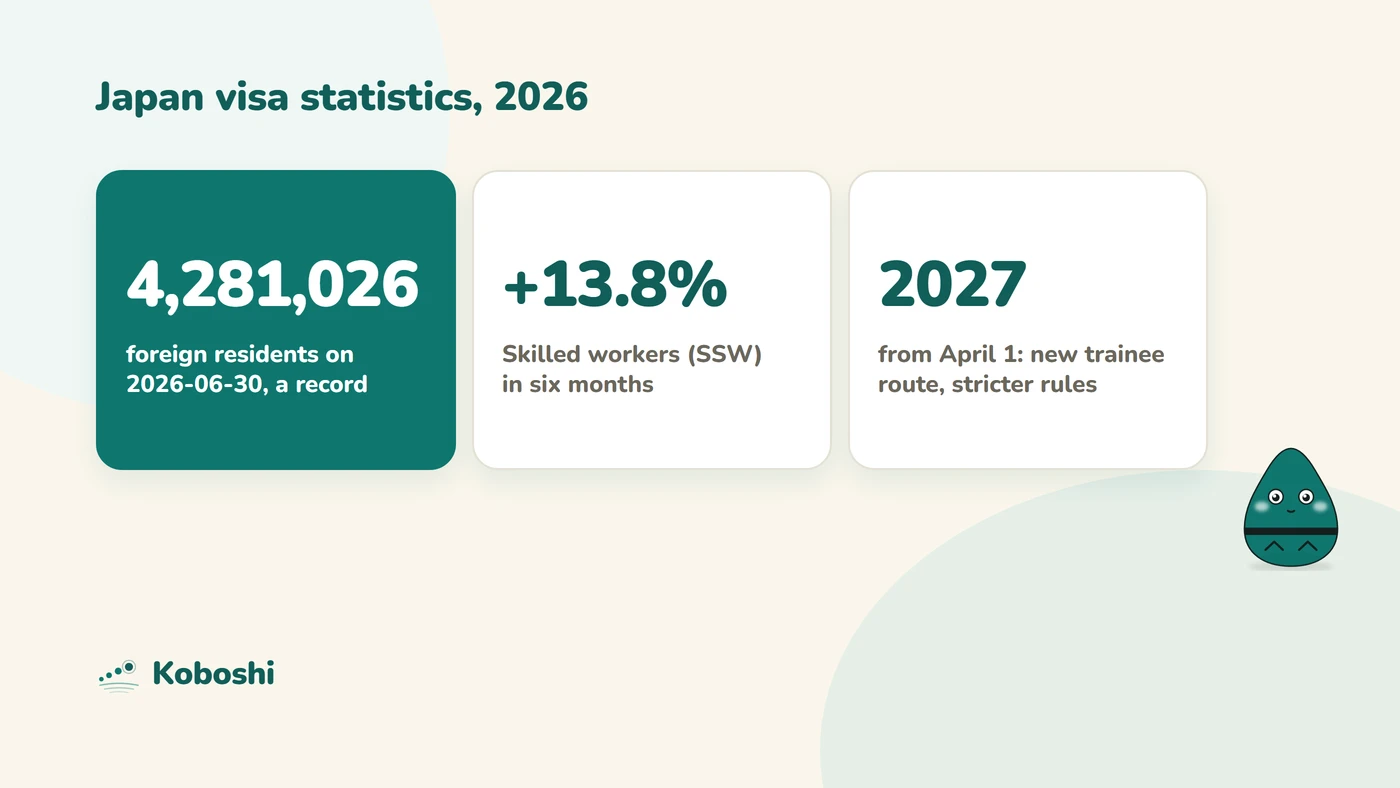
On 2026-06-30, a record 4,281,026 foreign residents lived in Japan, according to ISA. That was 155,631 (3.8%) more than the 4,125,395 at the end of 2025. These numbers count people holding a status on that day, not new arrivals (ISA press release; ISA tables).
| Status | People on 2026-06-30 | Net change since 2025-12-31 |
|---|---|---|
| Permanent resident | 961,342 | +14,217 |
| Office and IT work | 516,184 | +40,394 |
| Student | 479,626 | +14,842 |
| Technical intern | 457,509 | +891 |
| Specified Skilled Worker (SSW) | 444,256 (Type 1: 425,961; Type 2: 18,295) | +53,960 |
| Dependent (family of a foreign resident) | 370,466 | +17,591 |
| Spouse or Child of Japanese National | 153,940 | +1,042 |
| Highly Skilled Professional | 34,474 | +1,521 |
- SSW grew most of all statuses: 53,960 more holders in six months, up 13.8%. This is a net change: new holders minus those who left or changed status.
- Type 2 more than doubled: from 7,955 to 18,295 holders.
- Largest groups by nationality: China (941,031), Vietnam (693,750), South Korea (408,682), the Philippines (362,761) and Nepal (334,850). Nepal grew by 33,858 in the same six months.
What has changed in Japan’s visa rules since 2019?
Since 2019, Japan has opened new work routes and then tightened its Japanese, fee and residence rules. The main changes, oldest first:
| Date | Before | Now |
|---|---|---|
| 2019-04-01 | No SSW status | SSW starts; Type 2 in only 2 fields |
| 2023-08-31 | SSW Type 2 in 2 fields | Type 2 opens to 9 more fields, 11 in total |
| 2024-06-21 | Technical Intern Training is the trainee route | Law No. 60 of 2024 is published: Employment for Skill Development replaces it on 2027-04-01 |
| 2026-04-01 | Citizenship: 5 years in Japan | 10 years as a rule, with longer tax and insurance checks |
| 2026-04-13 | Restaurant SSW open | No new Certificates of Eligibility (COEs) for restaurant applications |
| 2026-04-15 | Office work visa: no Japanese rule | B2 (about JLPT N2) for jobs that mainly use language to deal with people |
| October 2026 intake | Language school: 150 hours of study counted as proof of A1 | An A1 test (about JLPT N5) or a school interview |
| 2026-10-01 | One-year renewal 6,000 yen; permanent residence 10,000 yen | One-year renewal 33,000 yen; permanent residence 200,000 yen, at the immigration office, for applications received from this date |
Sources: ISA SSW overview, ISA on SSW Type 2 fields, ISA on Law No. 60, Minister of Justice, 2026-03-27, ISA, 2026-04-13, ISA office work visa page, ISA language school rule, ISA fee leaflet, ISA fee Q&A.
What starts in Japan on 2027-04-01?
Each line links the summary that explains it, with its source.
- Trainee work: Employment for Skill Development replaces Technical Intern Training. See trainee work.
- SSW Japanese: every Type 2 field asks for B1 (about JLPT N3), for COE applications made from outside Japan. See skilled work without a degree.
- Permanent residence: applications follow the 2026-10-01 guideline in full, with a pension check and B1 Japanese as one factor. See permanent residence.
- Losing permanent residence: ISA can take it away for listed reasons, such as not paying taxes or social insurance on purpose. See permanent residence.
Where are the other Japan visa numbers?
Counts that belong to one route stay in that route’s guide:
- SSW workers in each field against the field’s cap, end of July 2026: Which SSW fields in Japan still have room?
- Engineer visa holders and new arrivals, all nationalities and Indian nationals, 2023 to June 2026: How many Indians hold the Japan engineer visa?
- Highly Skilled Professional holders by type, June 2026: What is Japan’s Highly Skilled Professional visa?
- Naturalization applications, grants and refusals, 2024 and 2025: Does Japan use a points system for naturalization?
Before you apply: This page is general information, not legal advice. Meeting these rules does not guarantee a visa; ISA decides each case. Rules change, so check ISA’s website on the day you apply. For your own case, ask a lawyer registered in Japan (弁護士, bengoshi) or an administrative scrivener approved to file immigration applications (申請取次行政書士, shinsei toritsugi gyoseishoshi). Sources last checked: 2026-10-23 to 2026-11-08.
