 Koboshi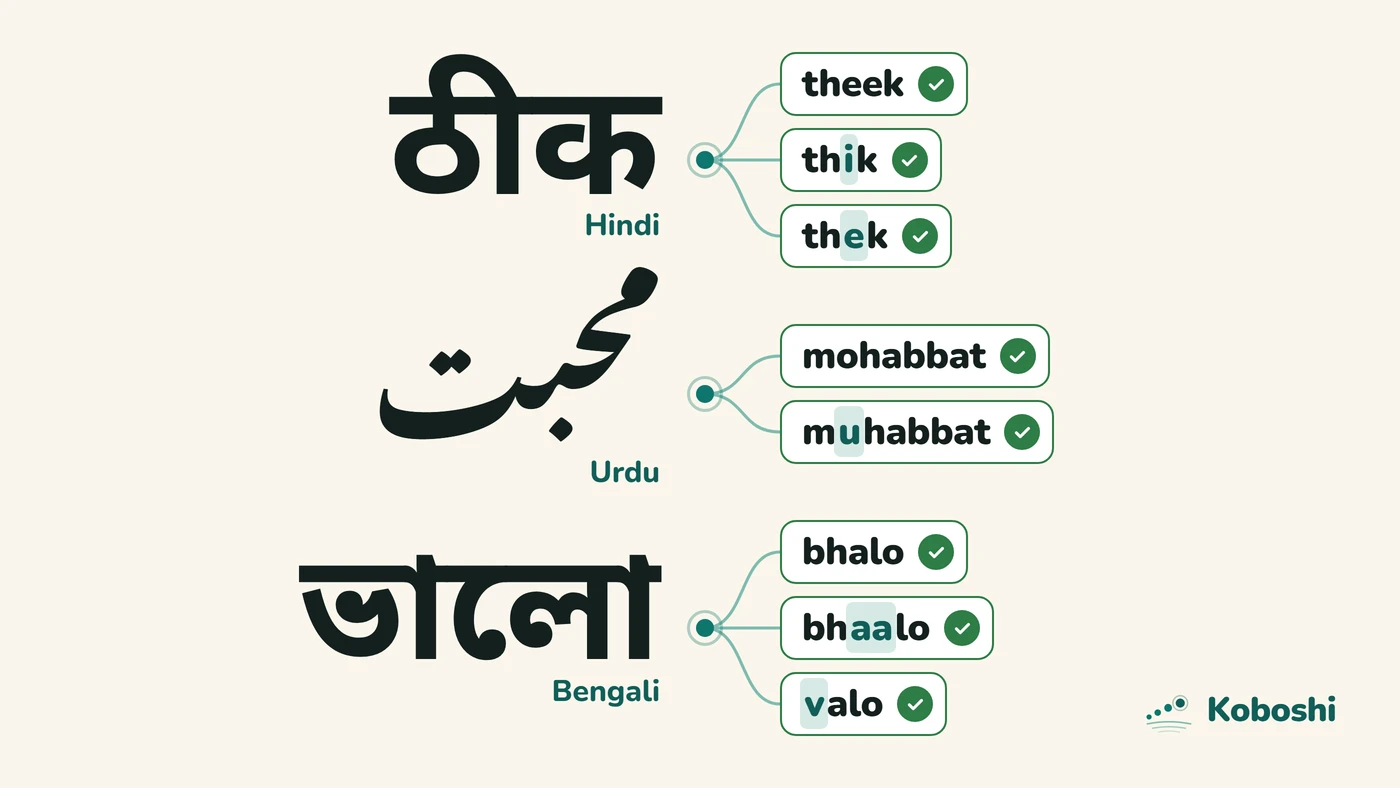
Koboshi now supports Hindi, Urdu, and Bengali answers in English letters. In the quiz, you can type a Hindi, Urdu, or Bengali word in roman letters, the way many of us text, and it counts. Every Hindi, Urdu, and Bengali word you save also keeps its romanized spelling.
Why are English letters needed for Hindi, Urdu, and Bengali speakers and learners?
We know you could perhaps write, but do not bother to write it, especially on digital devices.
For Urdu, a 2025 paper mentions Roman Urdu as “the dominant form of informal communication on platforms like Instagram, WhatsApp, and social media”, and its popularity is reasoned as “the lack of easy-to-use Urdu keyboards and familiarity with Latin characters” (Butt, Varanasi and Neumann, RANLP 2025). For Hindi, a 2014 study of 1,062 Hindi-English comments on the public Facebook pages of Amitabh Bachchan, Shahrukh Khan, Narendra Modi and BBC Hindi, collected in October 2013, found 93.17% written in Roman script and 2.93% in Devanagari (Vyas et al., EMNLP 2014).
The study is not the latest piece, but the trend should be almost the same.
Hence, the learning experience of Hindi, Urdu, and Bengali should not be stressful for their speakers, especially if they are heritage speakers who could speak already. Since at Koboshi, you could refresh your heritage language while learning the new language, the process needs to be stress-free enough to focus on the main learning language.
If you are learning Hindi, Urdu, and Bengali mainly as a learning language, then you should try to answer using their native fonts. This upgrade is just an easy and a bit lazy way for the natives to get around.
Which spellings count?
Each line counts as one word, whichever spelling you type:
- mohabbat or muhabbat (محبت, मोहब्बत, love)
- zaroor, zarur or zaror (ضرور, ज़रूर, of course)
- theek, thik or thek (ٹھیک, ठीक, fine)
- bhalo, bhaalo or valo (ভালো, good)
- khub or khoob (খুব, very)
The quiz would be extra lenient due to variations in how people express themselves in roman letters.
Why is Koboshi a great app for Hindi, Urdu, and Bengali speakers?
If you have roots in the Subcontinent (India, Pakistan, and Bangladesh), then you are most likely at least bilingual or more. English sits mostly with the educated and urban families. In India’s 2005 national household survey, about one adult in five could speak at least a little English, but 88.5% of college graduates could, against almost none of the adults with no schooling, and 34.8% of city dwellers against 14.1% of people in villages (Azam, Chin and Prakash, using the India Human Development Survey 2005). Pakistan has no national count of English speakers, but two numbers can be counted: in urban Punjab, 47% of children aged 6 to 16 go to private schools (ASER Pakistan 2023, Punjab), and UNESCO counts 114,849 Pakistani university students abroad in 2023, up from 24,601 in 2005 (UNESCO Institute for Statistics). In Bangladesh, English-medium schooling is a small and expensive slice: 148 of more than 21,000 registered secondary schools (BANBEIS, reported by The Business Standard, 2026). Also given huge social inequality in these regions, the chance is that most proactive learners would fall into the multilingual side.
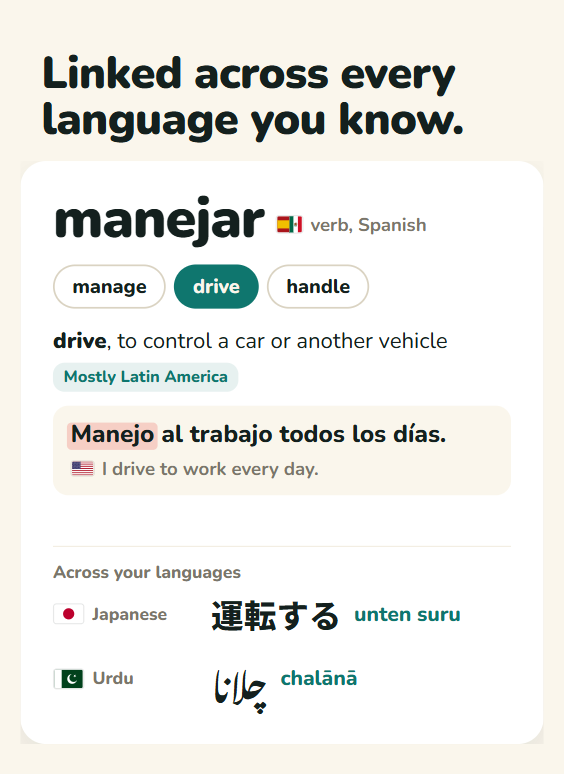
So, if you are learning a new language, then you would still want your native language to be shown so you could relate better and study well.
Also, did you know that Urdu, Hindi, and Bengali speakers who grew up with English at school are likely weaker in their native tongue than people who are truly monolingual, thanks to the society tolerant to English where people revert to English words in their daily conversations? The research points the same way. Children who grow up with two languages know fewer words in each single language than monolingual children: in a pooled study of 1,738 children aged 3 to 10, those who spoke another language at home (Hindi, Punjabi and Urdu among them) and English at school scored 96.3 against 106.8 on an English vocabulary test (Bialystok et al., 2010). A 2024 study of 743 toddlers in Montreal found the same in each single language, while both languages together came to more words than one (Byers-Heinlein et al., 2024). Linguists describe a language used mainly at home as lagging behind the majority language in vocabulary (Montrul, 2012).
Online, that mixing can be counted. In the 2014 Hindi Facebook study, about one in four comments written mainly in Hindi (93 of 398, 23.37%) slipped English words into Hindi sentences (Vyas et al., EMNLP 2014). In 51,277,891 words of the Hindi newspaper Dainik Jagran, “party” appeared “over 67K” times, while “the counts for the equivalent Hindi forms are relatively low” (Bali et al., 2014). For Bengali, about one in five posts (21.05% of 2,309) in campus Facebook groups at Jadavpur University mixed Bengali and English (Das and Gambäck, ICON 2014). And the 2025 Roman Urdu paper counts “frequent code-switching with English” among the complexities of Roman Urdu (Butt, Varanasi and Neumann, RANLP 2025).