Koboshi
Is it bad to learn two languages at the same time?
Mixing two languages helped adults remember words in a 2025 experiment (Second Language Research, Waisman Center report). Researchers at the University of Wisconsin-Madison taught German and Polish words to English speakers.
- One group learned one language, then the other.
- The other group mixed both in the same session.
- With no break, the mixed group remembered more words.
- With a rest between the languages, the first group did about as well.
Does a new language make you forget another one?
It can, and this is the cost of learning two at once. A 2024 study tested Dutch speakers who knew English (Quarterly Journal of Experimental Psychology). They learned Spanish words for half of 46 English words they already knew. Afterwards they recalled those English words less accurately than the other half. The tests ran right after learning and one day later. The authors wrote that a new language “comes at the cost of subsequent retrieval ability”.
So a foreign language you already know can get harder to recall while you add a new one. Keep reviewing it while you learn the new language.
Which language should you learn a new one through?
Use your strongest language. In a 2019 experiment, adults learned new Dutch words through English translations (Bilingualism: Language and Cognition). Bilinguals beat monolinguals only when English was their first language. The authors tied the advantage to learning “via the L1 or dominant language”, your first or strongest one.
Teacher Olly Richards calls learning through a second language “laddering” (StoryLearning). He writes that it is only “genuinely useful” when the two languages are very similar.
Which language combinations work?
This list is our own reasoning from the studies above and from how close the languages are.
Japanese speaker, English at B2, Spanish at A1 or A2: works. Read the meanings in Japanese, your strongest language. Many Spanish words look like English ones (información, information), so your English helps you recognise them. One school does this: Akita International University in Japan teaches its Japanese students English from B1 to C2. Its liberal arts program also requires every student to take another language besides English to graduate.
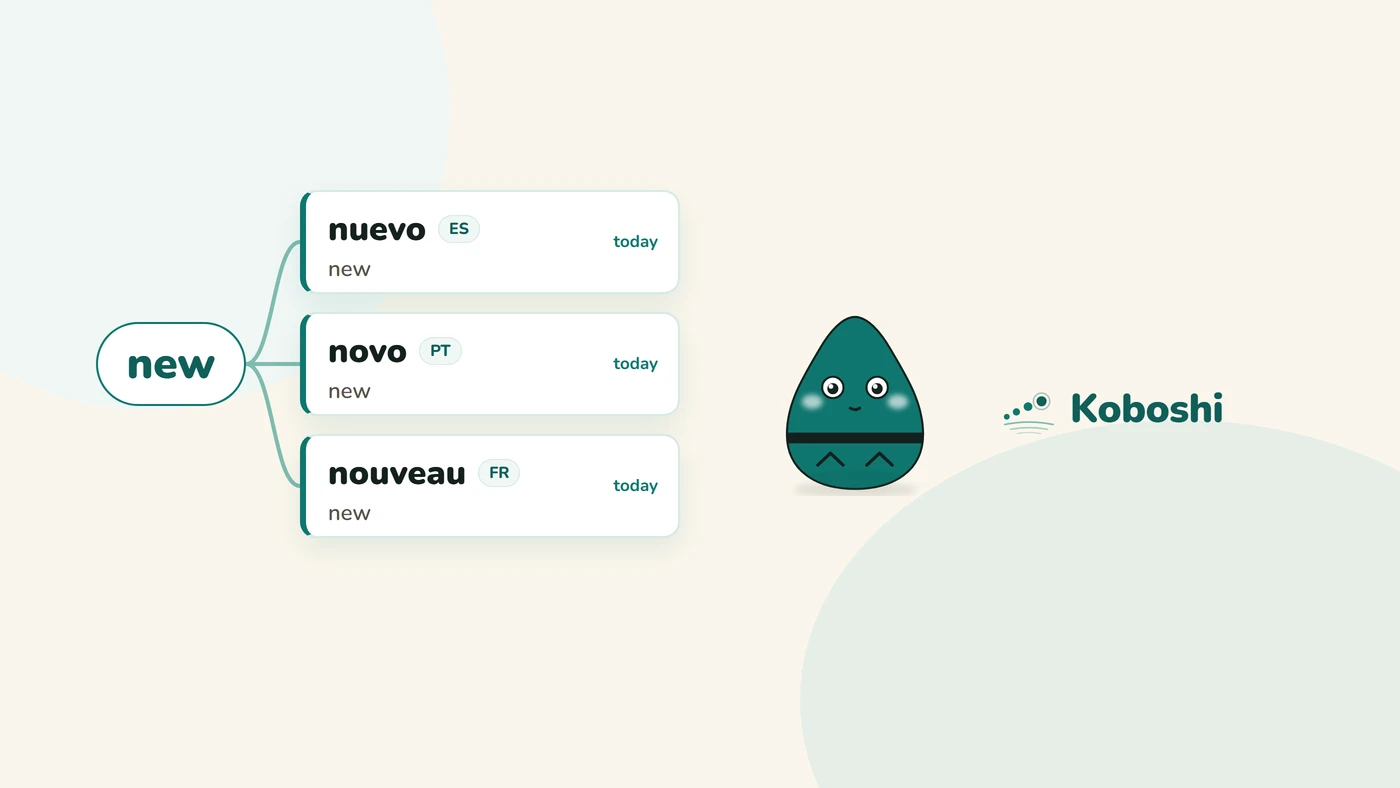
English speaker, Spanish and Portuguese: works for a fast start, but words mix up. The two are very close, so each helps you read the other. Many words differ by a letter or two, such as Spanish nuevo and Portuguese novo (new).
English speaker, Spanish and French: works. Both share many words with English, and they sound different enough to keep apart.
English speaker, Japanese and Chinese: works for reading, may not work for speaking at first. Many words share their characters and meaning, such as 学生 (student). The readings differ: gakusei in Japanese, xuéshēng in Chinese.
Chinese at B2, Japanese at A1: works. At B2 you already read many of the characters Japanese uses. Only the Japanese words are new, so fewer new words compete.
Two new languages at A1: works, with more to keep apart. The 2025 study taught two new languages at once, and mixing them in one session helped.
Can one flashcard app hold two languages?
Koboshi keeps every language you study in one place.
- Type a word, and Koboshi writes and saves its card.
- Each card can show the word in up to four more of your languages.
- Tap Helps on a translation that makes a word stick, and it shows in the typing quiz.
Easy Anki alternatives for language learning compares Koboshi with other flashcard apps.